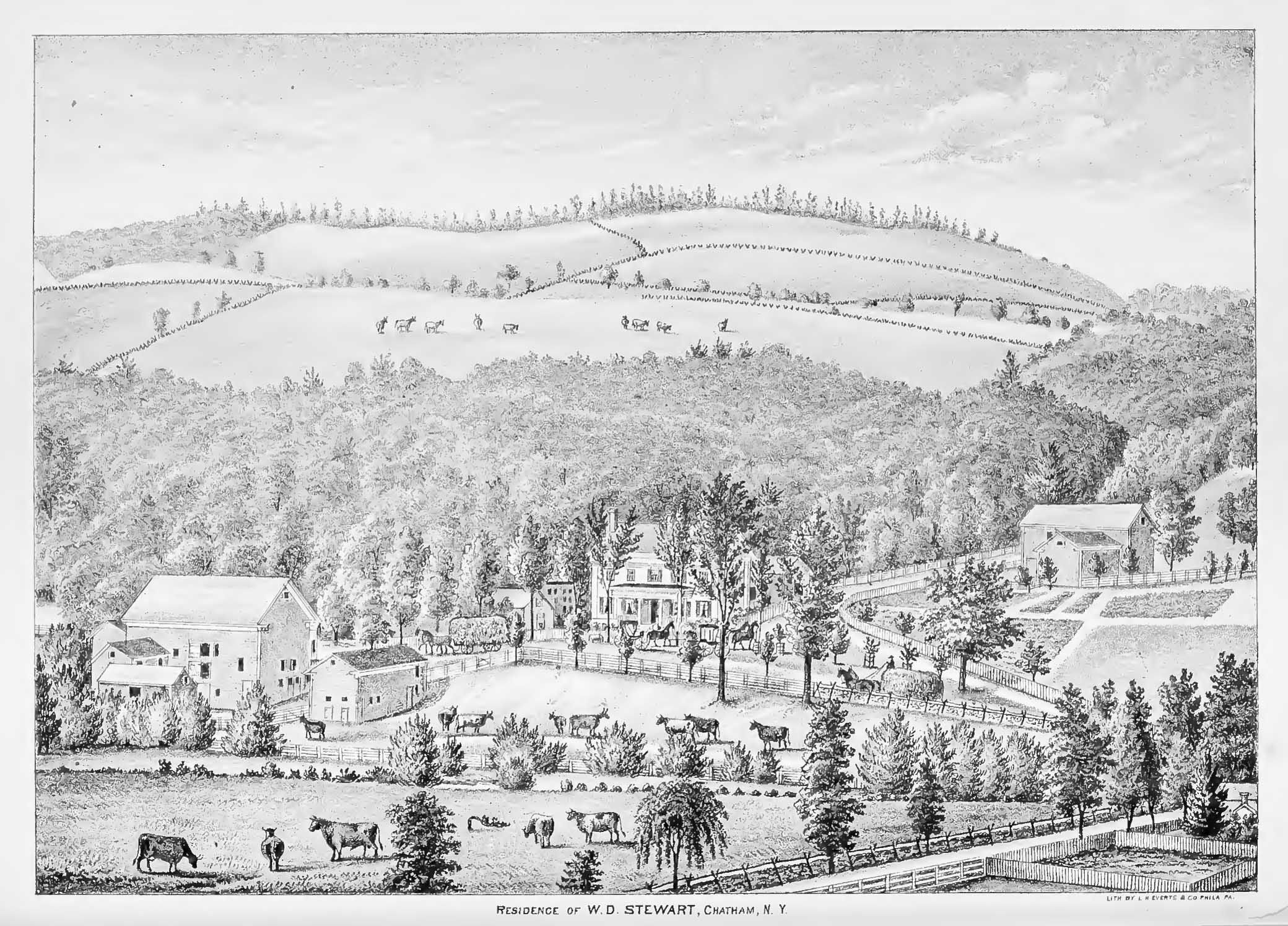
Stewart Farm House and Barns
The Stewart House
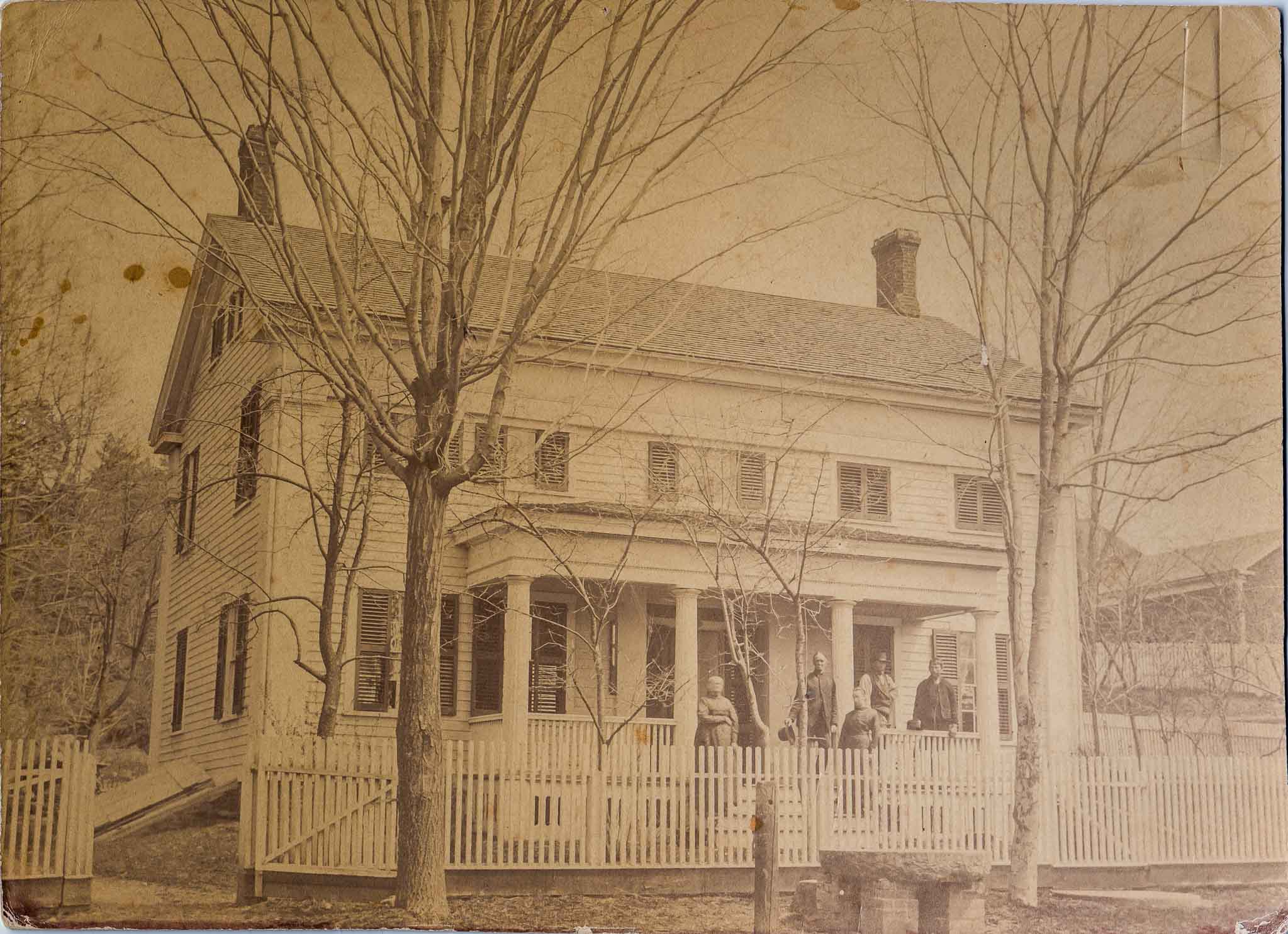
The Stewart House
circa 1881 - 1891
More about the house later - this page is a work in progress. jhc
The Stewart Barns

The Stewart Barns
There were a lot of barns on the farm back in the day. Most were gone by the time Dad bought the place in 1945. All that remained were the big barn, the corn-house, and a small brick smokehouse. Oh, and the converted woodshed ("the little house") we lived in until he built the new house.
When Were They Built?
I spite of my long held belief they were built in 1868 based on that date carved into a beam in the scale room I think that's way off. Based on a few clues I'm now leaning to the mid 1830's. I now think the 1868 date in the scale room may be the date the scale was installed.
Some Clues
A major clue: John & Albert Griswold borrowed $3,000.00 against the farm in 1834 and another $2,500.00 the following year. That's enough to build the whole shebang, I would think. They paid roughly that ($5,725.00) for the 210 acre farm 8 years earlier (with whatever buildings "old John Clark" had).
The house has the porch columns and faux corner columns found in farmhouses with some Greek Revival influence seen in early 19th century farmhouses in this area.
The barns were trimmed in a style common to this area by the first half of the 19th century (and for a long time thereafter).
The major barn framing was classic mortise and tenon pegged framing, hand hewn and used peeled logs with the upper side adzed flat for rafters. Peeled log rafters went out of fashion when sawmills came in and old growth timber was largely gone.
There wasn't much old growth timber left in the neighborhood by 1868.
There was a sawmill in Red Rock by 1868 and I think there was one here one the farm too but I don't know when, or how it was powered - steam engine maybe. There were a few remnants of it about the place. The main shaft and the blade (about 3ft) in the barn, and a huge lumber wagon axle I dug out of the gravel down by the crick. All date to before the turn of the century at the latest I think. The sawmill was here in 1915 - see below.
If memory serves, the framing braces and intermediate studs were rough-sawn on an up-and-down mill, not a rotary mill represented by the shaft and blade that were here.
The Big Barn
The main barn ("the big barn" to me), in a style common to this area, was a bank barn in an English style three-bay-with-threshing-floor. Built into a natural bank, this barn gave easy ground level access on the lower level for animals and also ground level access above for hay and grain storage in the side bays and a threshing floor in the center isle.
I remember the scale room in the main hay barn had the date 1868 carved into a beam over the scale which I now think was the date the scale was installed. The big double doors opened onto a floor scale for weighing loaded wagons. The hay mows were to either side and were filled right to the roof with hay. Their was a hay fork devise suspended from a track along the ridge of the roof to grab the hay off the wagon, hoist it up and over into the mow. It was pretty clever. When Dad was farming I remember a tractor driven winch that sat outside by the scale room door. How was that used? Or was it? The scales and floor beyond I remember being open right through to a door out the back of the barn. There was a short, maybe 3 ft high, wall along the right of that central isle separating the hay mow. That mow went right to the peak of the barn. On the right side there was the scale room in the front and another little room in the back. The floor above them went all the way front to back of the barn with an open mow that also went up to the peak. I don't remember what the little room in the back was used for. Maybe it was a tack room.
There was a wing off the right front out towards the road we called the wagon house. It had 3 horse stalls in the smaller bay next to the big barn and a double bay behind a pair of larger doors for wagon access and storage. There was a workbench in the back corner and stairs up to a full loft above for misc storage. That whole wagon house and horse stalls had 2 inch thick wood plank floors made of sycamore which is resistant to horse urine and very hard wearing too.
There was another smaller wing off the back of big barn with animal pens below and fodder storage above with access from the big barn.
That little tree with the picket around it finally died a couple years ago.
The small garage sized barn was gone before we arrived in 1945. I remember an ice house lined with sawdust on the lower level that may have been under that building.
See That Little Square Door Over the Team?
I'm told I fell out of that door, head first into a wheelbarrow, when I was two. Oh! Dad bought the farm in 1945. I was two. I feel a story coming on...
I remember that door being latched with a simple wrought hook into a wrought staple in the frame. How could a curious kid not lift that hook? A kid exploring Dad's new farm. I bet I'd never seen a real farm before. The stairs leading up, up, up, into the dark mystery above the wagon house, so tempting to a two year old! And this little kid-sized door. And a little hook. What's beyond that door? Plop!
Chickens were kept up there at one time. I remember that end of the second floor of the wagon house being covered in several inches of chicken shit. I don't think they were Dad's chickens. It was not fresh. I don't remember chickens on the farm but there must have been a few as I remember Dad chopping the head off one and letting it go running around with blood flying everywhere.
Lightning Struck the Barn
The closest lightning strike I’ve ever experienced hit about 30 feet from where I was standing in the driveway about where the ass end of the second ox from the right is standing in this picture. There is a door to the cow stable and stanchions on the lower level below the hay mow. It's right in the near corner of the hay barn kind of obscured by the fence and ox's tail in this picture (that is an ox, right?).
A lightning bolt went in through that open door and struck the copper water pipe on the ceiling above the door. Amazing! And LOUD! I can still remember it.
The Corn-house
The small building to the right in the picture is corn house where, as you might guess, the corn was stored. It had inwardly sloping vertical wood slat siding to keep water out but to allow air to pass through to dry the corn. It's now the only original building still on the place (other than a small brick smokehouse).
The corn-house has always been my favorite little building. For a long time I wanted to convert it to a small house. The interior is neat with the original hand hewn beams and the vertical slat siding. I wanted to keep that all exposed and build an insulated shell around the outside. Put a little bath and kitchen kind of in the center to preserve the look of the frame. Upstairs there is room for a bed and closet. The second floor doesn’t extend out to the exterior walls - just down the middle. I think they loaded the corn cribs along the outside walls from above. They were along the outside walls leaving the center downstairs open too. Maybe they stored wagons or equipment there.
The Corn-house (Corn Crib) Came Later
But before 1878 - it shows in Ellis' illustration.
It uses the classic mortise and tenon pegged framing.
It's framed with a mix of hand hewn timbers and sawn and planed braces and rafters and minor framing pieces.
When did a planer arrive in the area?
The loft joists are peeled logs adzed flat on top.
The few remaining loft floorboards are planed.
The vertical slat siding is planed.
The roof boards are waney-edged and planed.
The door boards are planed and beaded.
The first mention of a corn crib is recorded in a farmers almanac dating back to the year 1701. Corn cribs were rarely built on New England farms until the middle of the 19th Century, when growing 'Indian' corn became popular. Storing the corn on the cob in a well-ventilated corn crib allowed the kernels to dry without spoiling. The cobs were prized for use as oven ash that was used in smoking meats, as well as for quick kindling and numerous other purposes, making the need for corn cribs essential to the cultivators of the time.
From: https://www.newtownbee.com/08262005/the-adventures-of-an-american-corn-crib
The Trees Along Clark Road
The farm where the picture of my ancestors in the old car was taken is about a mile and a half from the farm and at one time was referred to as “the upper place.” That farm was also in the Goodrich family. Also in the family at some point was the farm half way between. So, Goodriches owned three of the four farms along that stretch.
One day as I came up Clark Road, I was thinking about those big old maple trees that were along the road, most gone now. They extended all the way along Clark Road from County Rt 9 to Raup Road, both sides of the road, about 50-100 feet apart. That’s not natural. They must have been planted. About the time that little tree by the barn was planted I'm guessing (it finally died a couple years back). See the one just in the frame to the left? I think the next one beyond that one is still standing though it died last year. Most of the others from there to the corner are gone now.
LOST THREE FINGERS
Gordon Goodrich Meets With Accident in Saw Mill
Three of Gordon Goodrich's fingers were cut off a few days ago when they came in contact with a buzz saw in the saw mill owned by his father, Fred Goodrich, near Red Rock. He was sent to an Albany hospital.
Transcribed from: The Chatham Courier, Wednesday, March 31, 1915
NOTE: This would have been at the Stewart Farm, then owned by F. C. Goodrich. jhc
References
https://en.wikipedia.org/wiki/New_England_barn
http://www.witheridge-historical-archive.com/harvesting.htm
https://nipmoosebarns.org/corn-crib-history/
https://en.wikipedia.org/wiki/Corn_crib
— revised 2024-07-14 jhc